



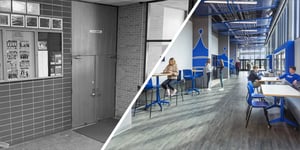
If you're planning a new school or considering how to update an existing one, you're facing a very different set of questions than your predecessors did decades ago. The way students learn, the tools they use and the expectations placed on schools have all shifted. What worked in 1975 doesn’t necessarily work today. And when you’re investing in a space meant to serve students for generations, you want to be sure the design supports how learning happens today with flexibility to grow into the future.
Rows of Desks and a Chalkboard
For much of the 20th century, school buildings followed a rigid model. Long corridors lined with boxy classrooms. Desks in rows. A teacher at the front, delivering instruction from a chalkboard. The goal was structure and control. Buildings were merely designed for efficiency.
In the 1970s, some schools experimented with open classrooms incorporating large, shared spaces without walls between classes. The idea was to foster collaboration. In reality, many of those schools ended up building walls later on. The space wasn’t designed to support multiple activities at once, and noise and distraction became real problems.
The Move to Flexibility
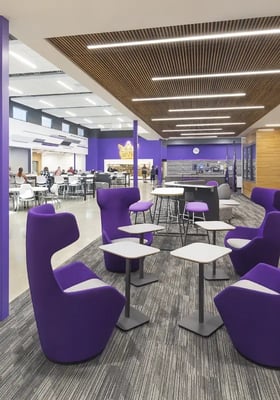
Today’s learning environments favor adaptability. Classrooms are designed to shift between group work, independent study and hands-on projects. Furniture often moves. Walls open and close. Common areas are activated as learning spaces.
Modern design allows educators to match the environment to the moment. A room might feel like a quiet reading space in the morning, then transform into a lively project hub by lunch. That flexibility helps schools keep pace with evolving teaching methods and student needs.
Technology Has Transformed the Classroom
Walk into a school built in the 1970s and you’ll probably still find chalkboards. Walk into a school built today and you’ll find wall-mounted screens, document cameras and students with laptops or tablets.
In older buildings, computer access often meant a trip to a dedicated lab. Today, devices are mobile and used throughout the day. That shift has changed the way classrooms are wired and arranged. Power access matters. Wi-Fi coverage matters. Charging stations and tech storage are now part of the plan.
The physical space needs to support seamless use of digital tools. That means smart board placement and thoughtful cable management. Good design makes tech feel like a natural extension of the classroom, not an add-on.
Security Is Part of the Design
Fifty years ago, schools didn’t think much about access control. Doors were often unlocked during the day. Visitors came and went without screening. Sadly, that’s no longer the reality.
Modern schools are designed with safety at the forefront. Secure vestibules guide visitors through a monitored entry. Classroom doors are built to lock quickly and from the inside. Windows are reinforced. Sight lines are clear, helping staff monitor common areas with ease.
The goal isn’t to make a school feel like a fortress. It’s to design security that works quietly in the background. Protective, but not oppressive.
Wellness, Comfort and Belonging
In many older buildings, classrooms are dim, institutional and uniform. In newer spaces, natural light and color are tools used to support well-being.
Designers think about how students move, where they sit and how they interact with their space. That might mean including quiet nooks for kids who need a break or collaborative areas for project work. It might mean creating spaces that are easier for students with physical or sensory needs to navigate.
Designed for How Students Learn Today
The biggest shift in school design is rooted in a new understanding of how kids learn. The traditional model treated students like passive listeners. Today, we know better. Learning is active and different for every student.
That’s why schools are now designed to support movement, collaboration and creativity. Classrooms connect to common spaces, outdoor areas and hands-on labs. Spaces are scaled to different activities, whether it’s a quiet corner or a wide-open makerspace.
Looking Ahead
If you’re thinking about the future of a school building, the past 50 years offer a lot to learn from. Flexibility, comfort, safety and technology have become fundamental. And while trends may change, the principle holds: design should always support how students and teachers actually work.
Check out our blog for more insights into design trends, or contact our team for expert guidance on your next project.